My homelab has picked up a lot of moving parts this year, and several of them are now LLMs. Claude Code runs natively on the box and does real work against real infrastructure — containers, reverse proxy config, monitoring, the lot. That’s genuinely useful. It also creates a trust problem I hadn’t had before.
The problem is simple to state: the same agent that makes a change also writes the summary explaining why the change was safe. That’s convenient. It is not independent verification. If the agent quietly skips a validator and then reports “config validated”, I have no signal at all. The report is the evidence, and the thing that wrote the report is the thing being checked.
So I built an assurance plane around it. Not to replace Claude, and not to promote a second model to administrator — just to make the agent’s actions observable, keep the evidence somewhere the agent can’t reach, and let something independent challenge claims it can’t support.
I had Codex build it, deliberately. The agent being audited didn’t write its own auditor.
What it actually is
Four independent layers of evidence, none of which the main agent controls:
- Managed lifecycle hooks. Claude Code lets you run a script before and after tool use.
These ones are installed as managed settings under
/etc/claude-code/managed-settings.d/, which is root-owned and sits above user and project settings in the precedence order. In plain terms: my ownCLAUDE.mdor a project’s.claude/settings.jsoncannot turn them off. - Claude’s native OpenTelemetry stream, scrubbed by a pinned collector before anything is written to disk.
- An append-only, hash-chained ledger — the durable record.
- Tiered model review after a session ends, with the verdicts scored in Langfuse.
The auditor itself runs as a separate systemd service under its own agent-audit user, with
no Docker socket, no D-Bus, no broad home-directory writes, and no privilege escalation. It
listens on loopback only.
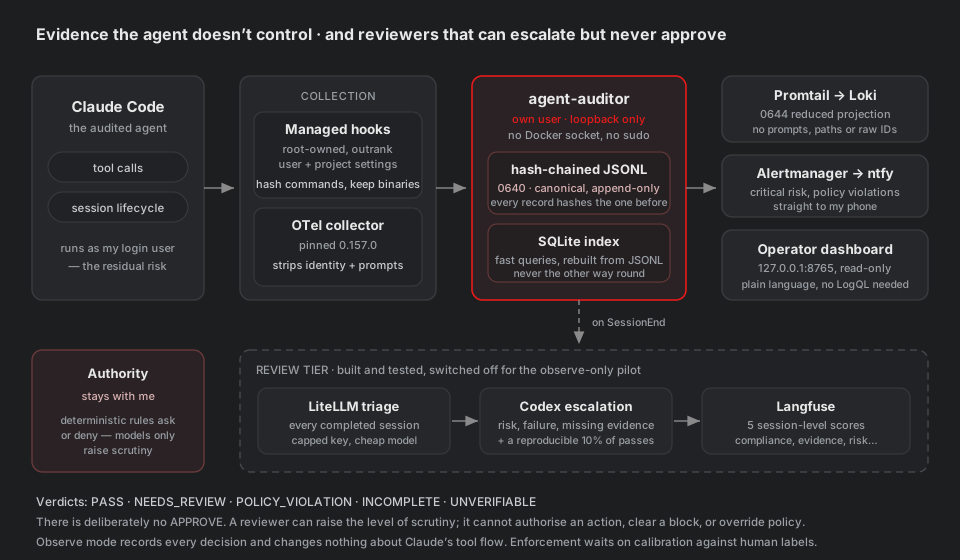
The shape of it matters more than the parts. Evidence flows left to right, away from the agent — each hop puts the record somewhere the agent has less ability to touch, ending in files it can’t write and a log platform it has no credentials for. And the whole bottom row is dashed, because it isn’t switched on yet.
The hash chain, in plain language
The ledger is a daily JSONL file — one JSON object per line, appended, never rewritten. Every record carries the SHA-256 hash of the record before it.
That chaining is the whole point. If someone edits record 12 after the fact, its hash changes, so record 13’s stored “previous hash” no longer matches, and every record after it is now inconsistent too. You can’t quietly change one line — you’d have to rewrite the entire rest of the file. A daily checkpoint anchors the chain head so a whole-file rewrite is visible as well.
There’s a SQLite index next to it that makes queries fast, but the JSONL is canonical. If the index gets corrupted or a write is interrupted, the index gets rebuilt from the JSONL, never the other way round.
Verifying it is one call:
curl --fail --silent http://127.0.0.1:8765/healthz
{"mode":"observe","review_enabled":false,"langfuse_enabled":false,
 "ledger":{"records":58,"valid":true,
           "head":"9f30ccf0433e4a7a79e6d4d06d4848439fa5b9d501a10a65b5ffffaea132f4e5",
           "anchor":"0000000000000000000000000000000000000000000000000000000000000000"},
 "review_queue_depth":0,"status":"ok"}
"valid":true means the chain recomputed cleanly end to end.
What gets recorded — and what deliberately doesn’t
This is the part I spent the most thought on, because an audit log that hoovers up prompts and command text is its own security problem. You’ve just built a second place for your secrets to leak from.
So the hook client sanitises before anything leaves the session. It hashes command text
rather than storing it, keeps only the binary name (docker, not the full command line),
normalises paths, strips message content entirely, and redacts anything credential-shaped on
the way past:
r"\b[A-Za-z0-9_]*(?:KEY|TOKEN|SECRET|PASSWORD)[A-Za-z0-9_]*\s*=\s*\S+"
Then there are two files, with different permissions and different audiences:
| File | Mode | Contents |
|---|---|---|
| Canonical ledger | 0640 | Full sanitised evidence, hash-chained |
| SIEM projection | 0644 | Severity, stage, outcome, policy category, hashed session refs |
Only the reduced 0644 projection goes to Promtail and into Loki, because Promtail runs
non-root inside its container and can only read what’s world-readable. That constraint turned
out to be useful rather than annoying: it forces the log platform to receive the smaller
dataset. No prompts, no command text, no paths, no tool output, no raw session IDs.
Queries look like this:
{job="agent-auditor"}
{job="agent-auditor", risk="critical"}
{job="agent-auditor", verdict=~"POLICY_VIOLATION|UNVERIFIABLE"}
Session references in there are one-way hashes. I can correlate everything one session did without the log itself telling anyone which session that was.
Two reviewers, different jobs
Once a session ends, its events become a metadata-only review packet. Deterministic completeness checks run first — before any model sees it — because “did the end-of-session record actually arrive” is a question code can answer, and code doesn’t hallucinate.
Then a cheap, capped model on my local LiteLLM gateway does first-pass triage on every completed infrastructure session. A deeper Codex review only runs when one of these is true:
- the task was medium risk or above;
- the first reviewer failed, or returned “can’t verify”;
- evidence is missing;
- a deterministic policy rule fired;
- a reproducible 10% sample picks it.
That last one matters. If you only escalate the scary-looking results, you never find out what your cheap reviewer is missing on the results that look fine. The sample is derived from the session ID rather than randomised, so the same session always makes the same decision and I can reproduce it later.
The reviewers get a deliberately tiny vocabulary:
PASS NEEDS_REVIEW POLICY_VIOLATION INCOMPLETE UNVERIFIABLE
Note what’s absent: there is no APPROVE. A reviewer can only increase scrutiny. It cannot
emit an authorisation, it cannot clear a blocked action, and it cannot override policy. Whether
a restart, a firewall change or a database migration goes ahead is decided by deterministic
rules and by me. Models are advisory, permanently — that isn’t a temporary restriction while I
build confidence.
Observe before enforcing
The first release records everything and changes nothing about how Claude’s tools behave.
That’s on purpose, and it’s the design decision I’d defend hardest. An uncalibrated guard is worse than no guard in both directions. False positives train you to click through warnings — and once you’re doing that reflexively, the real one goes through too. False negatives are worse: now you have a dashboard telling you everything’s fine, and you believe it.
So enforcement stays off behind explicit gates:
- at least 30 infrastructure sessions or two weeks in observe mode, whichever is longer;
- at least 50 human-labelled packets, balanced between “safe” and “escalate”;
- a 20% test split I don’t get to look at while tuning;
- both true-positive and true-negative rate above 0.90 on that held-out split.
Fail the gate and the system stays advisory. Pass it and models are still advisory — only
deterministic rules ever change tool flow, returning ask for operations that need my approval
and deny only for secret material or dangerously broad destruction.
Right now it reports exactly that, and I’d rather it be honest than impressive:
"notices": [
  {"level":"info","title":"Independent AI review is not active yet",
   "detail":"The observe-only pilot is collecting evidence before reviewer calibration."},
  {"level":"info","title":"Observe-only mode",
   "detail":"The auditor records policy decisions but does not change Claude's tool flow."}
]
A dashboard, because LogQL is not an interface
Loki and Grafana are the forensic backend, but I didn’t want “was anything weird today” to require writing a query. So the auditor serves a small read-only console on loopback that answers four questions in plain English: is the evidence chain healthy, is Claude active or finished or missing an end record, which sessions need a closer look, and what happened in a given session.
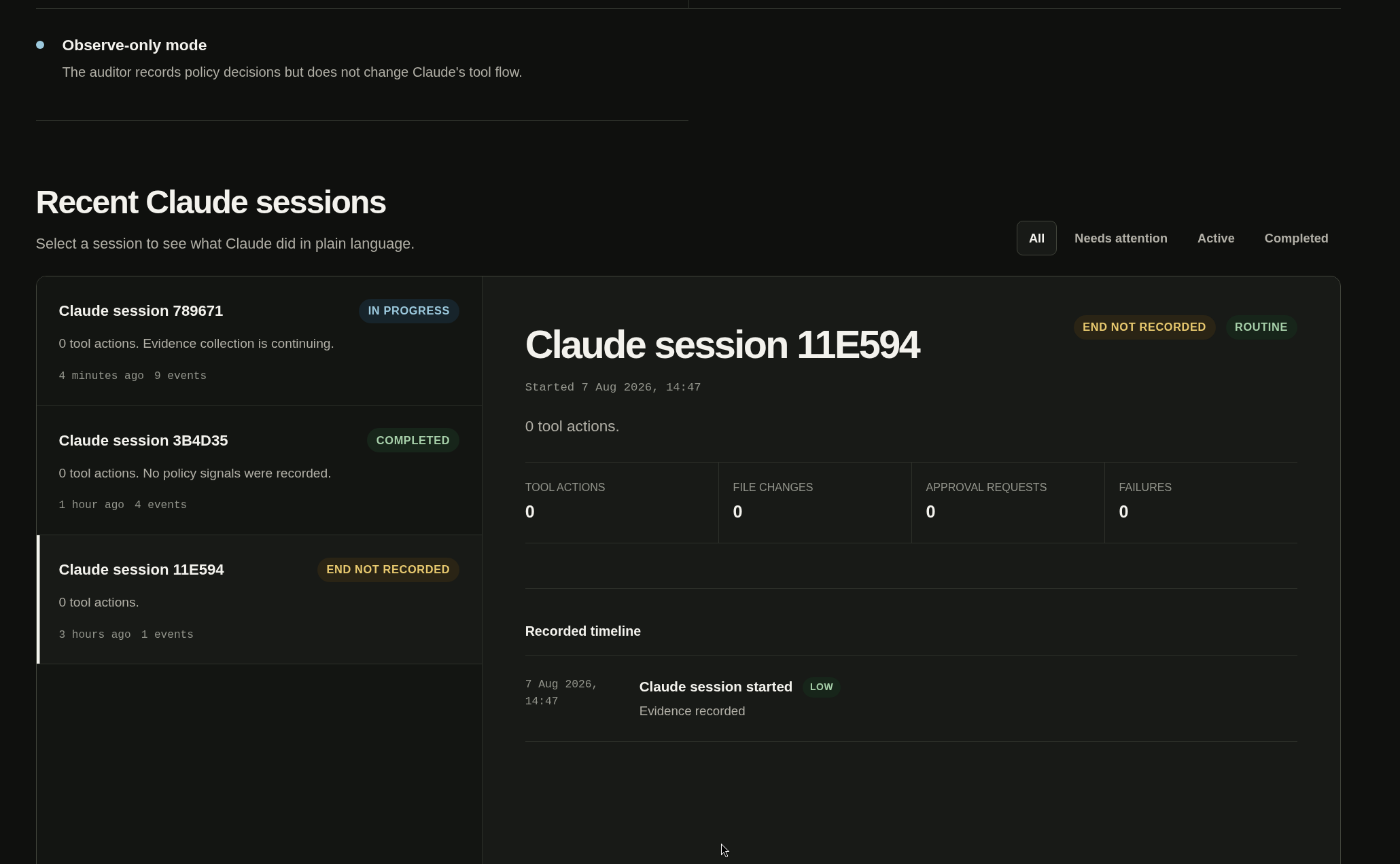
Honest note about that screenshot: every session in it reads 0 tool actions. Those sessions predate the tool hooks going live, so all the auditor had was session start and end. It looked underwhelming and it was correct — which is the behaviour I want. It reports what it recorded, not what it assumes happened.
It fills in properly once tools are actually running. Here’s the live feed while I was writing this post:
{"type":"PreToolUse","risk":"low","outcome":"decision:observe",
 "title":"Claude prepared to use Bash",
 "detail":"Command tools: cd, python3, python3, head"}
Binary names, no arguments, no paths. That’s the session that wrote this post, being audited while it wrote it.
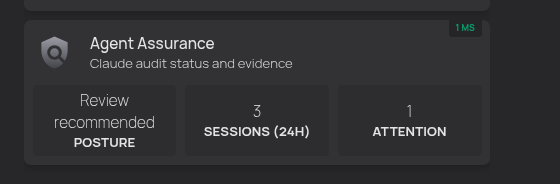
I also surfaced posture on my existing Homepage dashboard, so I see it without going looking:
Reusing what’s already there
I built almost no new infrastructure for this, which was a goal rather than an accident:
- Langfuse groups traces and holds five session-level scores — policy compliance, evidence completeness, change risk, review status, reviewer agreement;
- LiteLLM supplies the capped first-stage reviewer through a dedicated key;
- Loki and Grafana handle investigation and alert rules;
- Alertmanager and ntfy push urgent findings to my phone;
- the existing claim/handoff protocol ties every session to a declared scope.
Each system answers a different question, and keeping them separate is what keeps them honest. Langfuse tells me how the reasoning pipeline behaved. Loki tells me what event happened and when. The hash chain tells me whether the stored sequence still matches what was originally written. None of those three can quietly cover for another.
What this does not solve
Worth being blunt, because a security control you’ve oversold is a liability:
Shared identity is the real hole. The main Claude process and the hook process run as the same login user. The hardened service stops ordinary agent behaviour from editing stored history, but a fully compromised login could fabricate additional loopback events. Genuinely fixing that means running the agent under its own OS identity, or collecting below the user boundary. This is protection against mistakes, missing evidence, ordinary policy bypass and overconfident reporting — not against a compromised account.
A checkpoint is not a timestamp. Daily checkpoints are tamper-evidence anchored on my own machine. They are not third-party attestation. Someone with root and patience can rewrite the lot.
The judge is not automatically right. A second model being different doesn’t make it
correct. Its judgements need human labels, held-out evaluation, disagreement review, cost
monitoring and periodic recalibration. That’s why the review pipeline is built but switched
off — "review_enabled": false in the health output above is the current, accurate state, not
an oversight.
The bit that changed how I work
The most useful shift wasn’t technical. It was starting to treat agent output as a claim rather than as evidence.
A completion report saying “I validated the configuration” is a claim. The assurance plane asks the follow-up questions: did a validator actually run, was the result recorded, did the work stay inside the scope it declared, and can an independent reviewer trace that conclusion back to recorded facts?
That’s a modest goal. It also changes the relationship. The agent can still move fast — I haven’t slowed it down at all, since observe mode doesn’t touch its tool flow. But I can now see what happened, challenge what can’t be proven, and keep the authority for consequential changes where it belongs, which is with me.
Next step is the boring one: two weeks of observe mode, then sitting down and hand-labelling fifty sessions so the reviewer has something real to be measured against.