Claude Code is the main LLM running my homelab. It builds, debugs, and documents most of what happens on the Debian VM. But I wanted to try other models — and give the CLI tools a shared backend — without wiring up a different SDK and API key for every provider.
So I put a gateway in front: one endpoint, many models. Claude stays the main driver; everything else is now one config line away.
The shape
Three containers, dropped into the Caddy + Authentik + Langfuse stack I already run:
- LiteLLM — the router. Speaks both the OpenAI (
/v1/chat/completions) and Anthropic (/v1/messages) APIs, and forwards to whatever model a request names. - Open WebUI — the chat frontend. Model picker, side-by-side compare.
- OpenRouter — one upstream key that fans out to hundreds of models, so LiteLLM only needs a single credential.
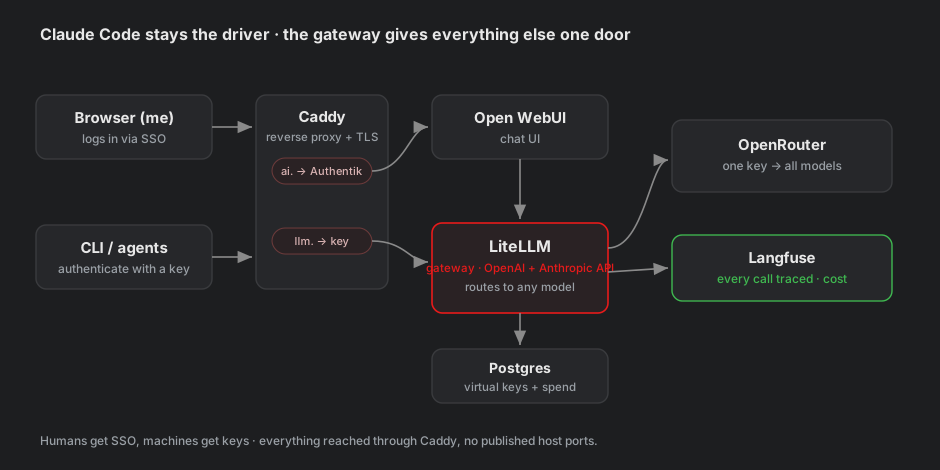
No published host ports — everything is reached through Caddy, same as the rest of the lab.
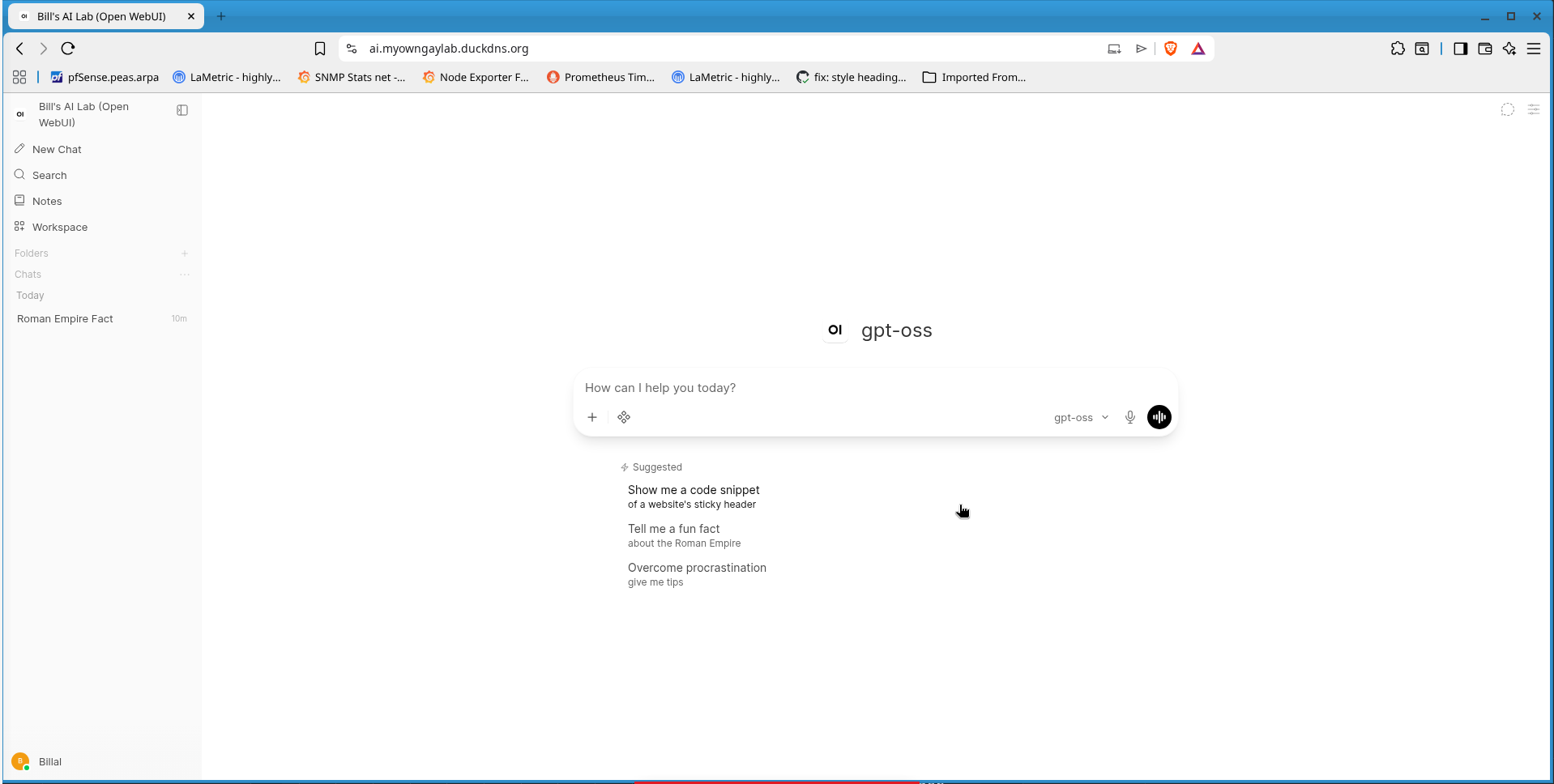
The one real design decision: humans get SSO, machines get keys
The chat UI is for me, in a browser. The gateway endpoint is for CLI agents, which can’t do an interactive login. So the two subdomains are authenticated differently:
ai.(Open WebUI) sits behind Authentikforward_auth— I log in once via SSO. I disabled Open WebUI’s own login (WEBUI_AUTH=false) so there’s no second prompt behind the SSO one.llm.(LiteLLM) is not behind SSO. It’s protected by an API key instead, because that’s what a script can actually present.
The Caddy blocks mirror the pattern my other gated services use:
# chat UI — Authentik SSO
@ai host ai.mylab.duckdns.org
handle @ai {
    route {
        reverse_proxy /outpost.goauthentik.io/* authentik:9000
        forward_auth authentik:9000 {
            uri /outpost.goauthentik.io/auth/caddy
            trusted_proxies private_ranges
        }
        reverse_proxy open-webui:8080
    }
}

# gateway API — key auth only, for CLI agents
@llm host llm.mylab.duckdns.org
handle @llm {
    reverse_proxy litellm:4000
}
The config
The model list maps a friendly name to an OpenRouter slug. A single key drives all of them:
# litellm-config.yaml
model_list:
  - model_name: gpt-oss
    litellm_params:
      model: openrouter/openai/gpt-oss-20b:free
      api_key: os.environ/OPENROUTER_API_KEY
  - model_name: laguna-code
    litellm_params:
      model: openrouter/poolside/laguna-s-2.1:free
      api_key: os.environ/OPENROUTER_API_KEY
litellm_settings:
  success_callback: ["langfuse"]   # every call traced
general_settings:
  master_key: os.environ/LITELLM_MASTER_KEY
  database_url: os.environ/DATABASE_URL   # Postgres: virtual keys + spend
One thing worth knowing up front: on OpenRouter’s free tier there is no Claude, GPT-4o, or
Kimi-K2 — those cost credit. I built and tested the whole pipeline on free models
(gpt-oss-20b, a couple of coding models), which is enough to prove every path works. Adding credit
and uncommenting the paid models is a one-line change later; nothing else moves.
Things that bit me
Reasoning models return an empty reply if max_tokens is small. My first test came back blank:
{ "content": null, "finish_reason": "length" }
gpt-oss spends completion tokens on hidden reasoning before the visible answer. With
max_tokens: 20, all 20 went to reasoning and nothing was left for content. Bumping it to 200+
fixed it instantly. Cheap lesson, but a confusing one when the HTTP status is 200 and the body is
just… empty.
Editing the Caddyfile did nothing until I restarted the container. The Caddyfile is a
single-file bind mount. My editor replaced the file’s inode, so the container kept serving the old
one — a caddy reload just re-read the stale inode. The new route simply wasn’t there:
docker exec caddy grep -c "@llm host" /etc/caddy/Caddyfile # -> 0, despite the host file having it
Fix is a full docker restart caddy, not a reload, whenever the file itself changes. Confirming the
count is 1 afterwards is now a habit.
The chat UI 404’d instead of showing a login. Wiring forward_auth in Caddy isn’t enough on its
own — Authentik’s embedded outpost has to know the hostname. Until I created the Application +
forward-auth provider and added it to the outpost, the outpost returned a 404 for ai., and Caddy
faithfully passed that through. Once the app existed, the same URL flipped to a clean 302 → login.
docker: permission denied right after adding myself to the group. usermod -aG docker had
registered in the group database, but the running shell predated it. Rather than reboot mid-build, I
wrapped commands with sg:
sg docker -c 'docker compose up -d'
Verifying it end to end
# models (OpenAI style)
curl -s https://llm.mylab.duckdns.org/v1/models -H "Authorization: Bearer $KEY"

# a completion
curl -s https://llm.mylab.duckdns.org/v1/chat/completions -H "Authorization: Bearer $KEY" \
  -H "Content-Type: application/json" \
  -d '{"model":"gpt-oss","max_tokens":250,"messages":[{"role":"user","content":"Reply: gateway online"}]}'

# Anthropic style — the format Claude Code speaks
curl -s https://llm.mylab.duckdns.org/v1/messages -H "x-api-key: $KEY" \
  -H "anthropic-version: 2023-06-01" -H "Content-Type: application/json" \
  -d '{"model":"gpt-oss","max_tokens":250,"messages":[{"role":"user","content":"Reply: gateway online"}]}'
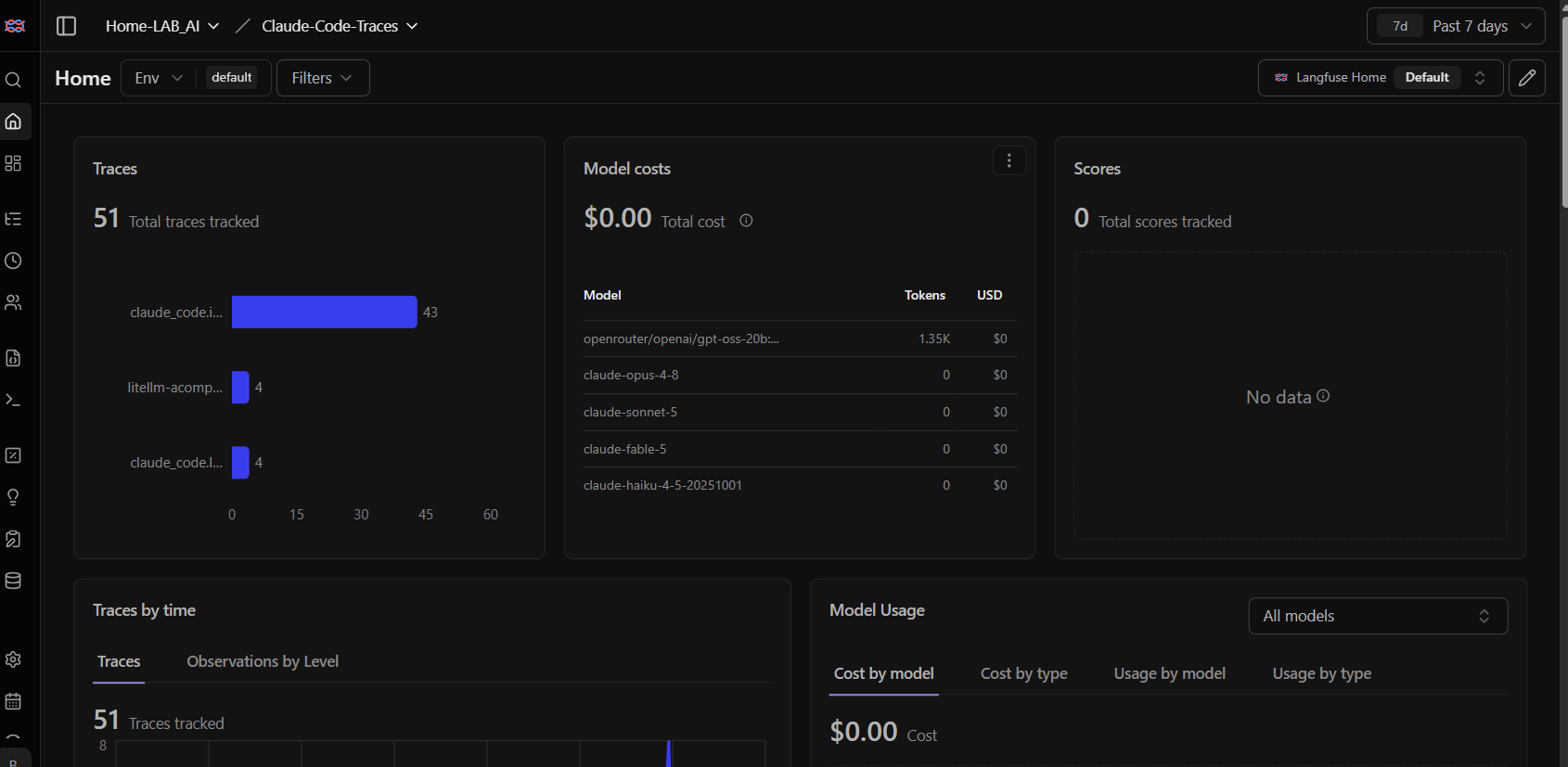
All three returned gateway online, and — because success_callback is on — a matching trace showed
up in Langfuse seconds later, with token counts and cost. Cost is $0 for now; the free models report
zero, and the Postgres behind LiteLLM is already tracking spend for when it isn’t.
Where Claude Code fits
Nothing about my Claude Code workflow changed — it’s still the main driver. What the gateway adds is a shared, traced, access-controlled backend that other tools can point at. A small wrapper sends Claude Code through the gateway when I want it to:
export ANTHROPIC_BASE_URL="https://llm.mylab.duckdns.org"
export ANTHROPIC_AUTH_TOKEN="$LITELLM_VIRTUAL_KEY"
claude "$@"
LiteLLM translates the Anthropic /v1/messages calls to whatever model I route to. Driving Claude
Code onto non-Claude models this way is experimental — it works, but it’s clearly happiest on a
Claude model. Plain claude still talks to the real Anthropic API, untouched.
That’s the whole point of the exercise: keep the tool I rely on exactly as it was, and give everything else in the lab one clean door to walk through.