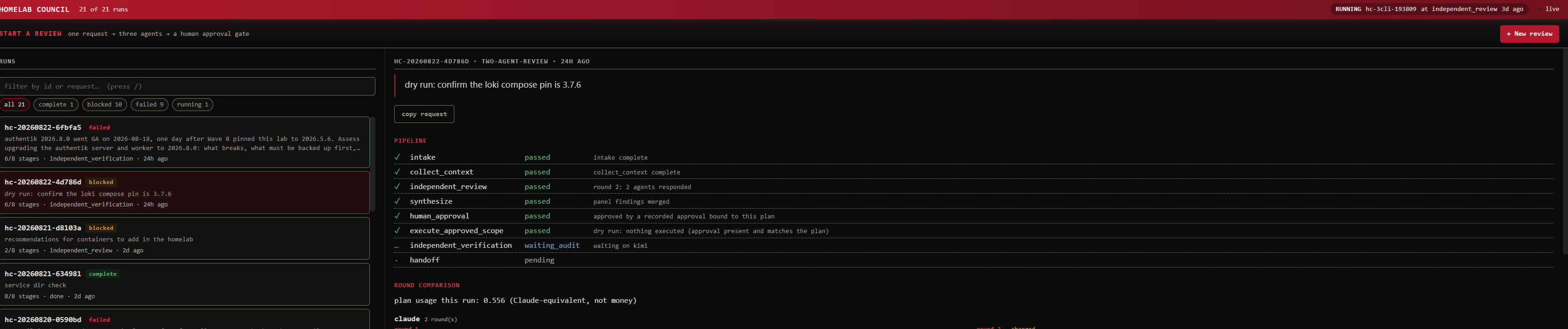
The council worked. One request went to Claude, Codex and Kimi, they answered independently, and nothing touched the lab without a human approval bound to a hash of the exact plan.
It also lived entirely in a terminal, which meant that to approve a run I had to
type a run id like hc-20260822-6fbfa5 and then re-type the original 350-character
request verbatim, because resume rebuilds the context pack from it. Get one
character wrong and you have quietly changed the inputs the agents were judged on.
So I built a dashboard. This is what it is, and — more usefully — the six things that broke once I had something I actually had to look at every day.

The constraint that shaped everything
Codex reviewed the idea before I wrote any of it and set one rule I kept:
The browser never gains authority the terminal does not have.
Concretely: no credential is ever sent to the page, the browser cannot start a mutation, and it submits an approval bound to a plan hash that the server computes. The orchestrator still re-checks the record and the claim before anything runs. The dashboard renders history and collects one decision.
It’s standard library only — ThreadingHTTPServer, a few JSON endpoints, one
page served from memory. The venv had no web framework and I didn’t want to add
one to a box whose blog runs Hugo specifically to avoid a dependency tree.
Agent replies go into the DOM with textContent, never as markup. They quote
shell and YAML; interpolating them as HTML would let a model’s output execute in
the browser of the person reviewing it. There’s a test that greps for
innerHTML, insertAdjacentHTML, document.write and outerHTML.
Then I started using it
1. The poll was eating what I typed
Text entered into the approval box vanished as I typed it. The five-second
refresh rebuilt the pane with replaceChildren(), taking every half-filled
field with it. There was a pause button, but needing it to fill in a form isn’t
a workaround — it’s the bug wearing a hat.
Fixed twice over: the pane is never rebuilt while any field in it holds text, and an unchanged run doesn’t rebuild at all. Then I replaced polling with server-sent events, which removes the conflict at the source rather than guarding around it.
2. A comment ate the end of a statement
setInterval(()=>{...} // sel is null while the form is open},5000);
The // comment I’d added in the previous change swallowed the },5000); that
closed the arrow function. The script didn’t parse, so nothing ran: header stuck
on “loading”, no runs, no panel health. One line, three broken features.
Three hundred Python tests passed the whole time. To Python it was a perfectly
valid string. I had a test asserting the page contained no innerHTML, and no
test asserting the page worked.
The suite now extracts the inline script and runs node --check over it. That’s
the project’s own rule — move validation into code rather than trusting a careful
read — applied to the one file that had no checker at all.
3. The columns assumed nothing was above them
I added a band at the top for starting a review. The two columns below still had
height: calc(100vh - 38px) — the header, and nothing else. The sidebar ran past
the bottom of the window with its scrollbar below the fold, so older runs weren’t
just off-screen, they were unreachable.
The magic number stopped being right the moment something appeared above it, which is the argument against having written it. It’s a flex column now and nothing needs to know how tall anything else is.
4. A correct refusal that arrived as an empty 500
Recording a second approval failed with “unexpected end of JSON input”.
The cause was the design working. Approvals carry a UNIQUE constraint on run
and stage because they’re single-use — no blanket approvals, no quietly widening
one that exists. But sqlite3.IntegrityError went unhandled, so the server
returned an empty 500 and the page could only report that it had failed to parse
nothing.
5. A run that died yesterday still advertised itself as running
I’d killed a TUI mid-approval a day earlier. Nothing rewrote the row, so the
record claimed human_approval: running indefinitely — and the header strip I’d
just built to show live activity displayed it as live.
There’s no process table worth consulting: the orchestrator may have been started from a terminal that’s long gone. The event log is what’s reliable. Every stage transition appends to it, so a run genuinely working writes something within its own stage timeout, and one that hasn’t, isn’t.
silent for 1296 minutes -> interrupted
Forty-five minutes is the threshold, deliberately generous — a review stage allows fifteen minutes per agent and a panel can sit quiet for most of it. The display relabels; the stored status is untouched and travels alongside, because the dashboard doesn’t get to edit history.
6. My own hardening broke the agents
I resumed a run from the browser. It reached independent_verification and then:
codex: error Error: failed to initialize in-process app-server client:
Read-only file system (os error 30)
Not a codex fault. The dashboard’s unit runs ProtectHome=read-only with write
access to the runs directory and nothing else, and agents spawned as its children
inherit that. Codex keeps an app-server socket and a sqlite database under
~/.codex; Claude keeps session state under ~/.claude.
The easy fix is widening ReadWritePaths until the agents work. That hands a
service reachable from a browser write access to both agents’ credential
directories, to solve an inconvenience. Worse trade than the problem.
So the dashboard no longer starts agents at all:
browser ──▶ dashboard   (sandboxed, reachable, holds no credential)
                 │  writes a validated job file
                 ▼
            runs/_queue/
                 │
            runner      (not sandboxed, not reachable) ──▶ claude / codex / kimi
The worker isn’t confined, because the agents genuinely need their state. It’s protected by being unreachable rather than by being restricted. Run ids and workflow names are validated twice — at the endpoint and again in the worker — because the file between them becomes a command line and was written by something exposed.
One job at a time. This guest has frozen from concurrent heavy work before.
What the dashboard is actually for
Two things the terminal genuinely couldn’t do.
Round comparison. Each agent’s round 1 next to its round 2. The panel’s value is the correction between them — “my position is revised”, “the claim that both logs are 0640 is false” — and that’s invisible in a scrolling transcript.
The Kimi handoff inline. Kimi is human-mediated on purpose — I asked Codex to review a headless launcher for it and took its advice not to build one. So every run that includes Kimi parks and waits for a paste. That used to mean Mousepad, a second terminal and retyping the request. Now it’s on the page.
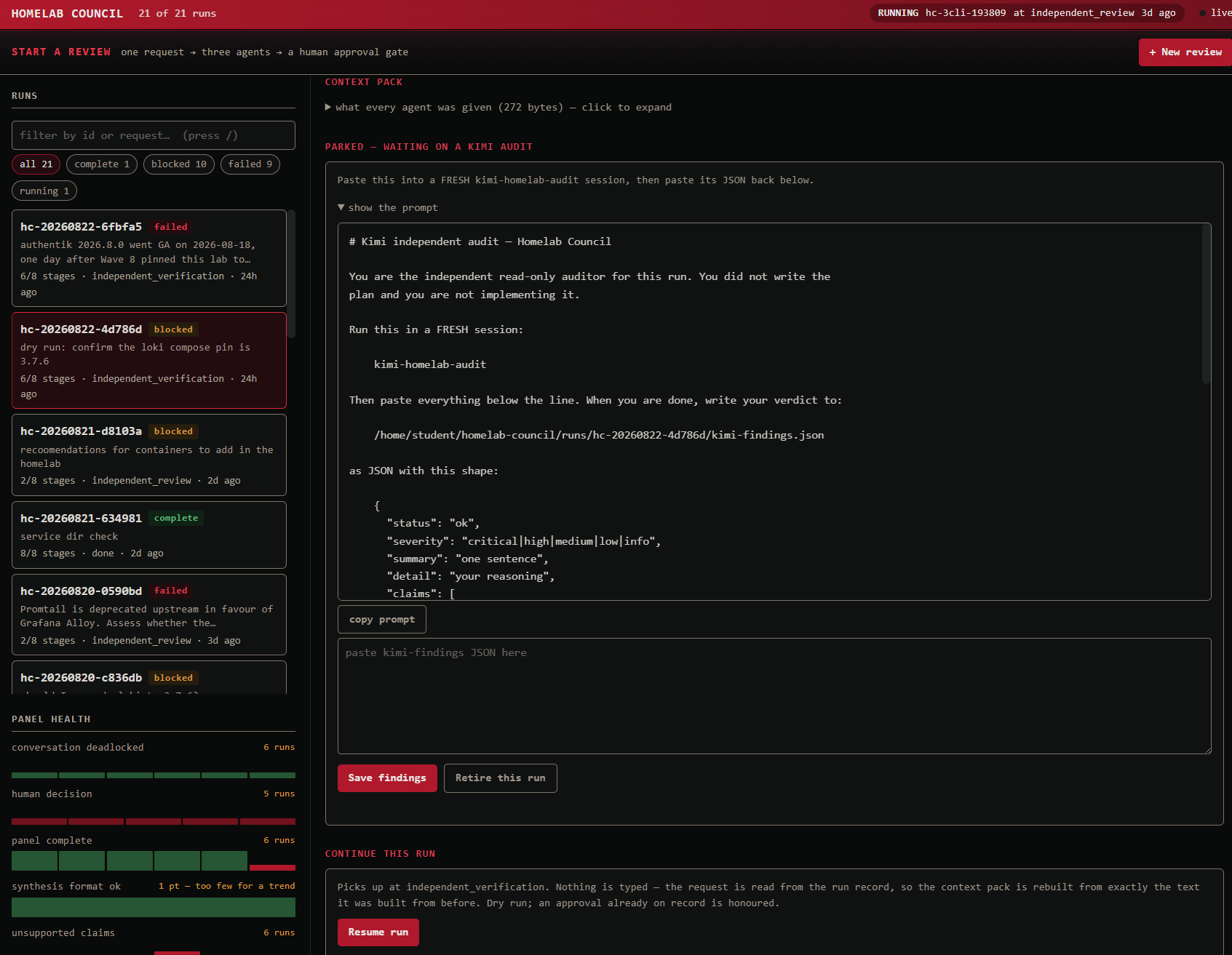
Panel health is the six scores each run emits to Langfuse. Note what it says
under synthesis format ok: “1 pt — too few for a trend”. Two points make a
line and a line looks like a conclusion, so a series with fewer than three real
points refuses to draw one. Runs that aren’t real runs — my own probes while
building the score emitter — are dropped rather than padding the chart with data
about nothing.
The thread running through all six
Every one of these was the same failure in different clothes: something absent rendering as something healthy.
A form that lost your text looked like a form you hadn’t filled in. A dead script
looked like a page still loading. A dead run looked like a live one. An empty 500
looked like a parse error. A score that never sent looked like a score of zero —
that one bit me earlier in the week, when a categorical value sent as a number
got a 400 that my own fail-safe swallowed.
So the page renders empty and unavailable differently on purpose, and a test
enforces it. When the stream drops, the indicator says reconnecting… with
backoff until it genuinely is — it never sits on “live” while blind.
Where it sits now
It runs as a systemd unit behind Authentik forward_auth, bound to the Docker bridge rather than the LAN, alongside everything else on the board.
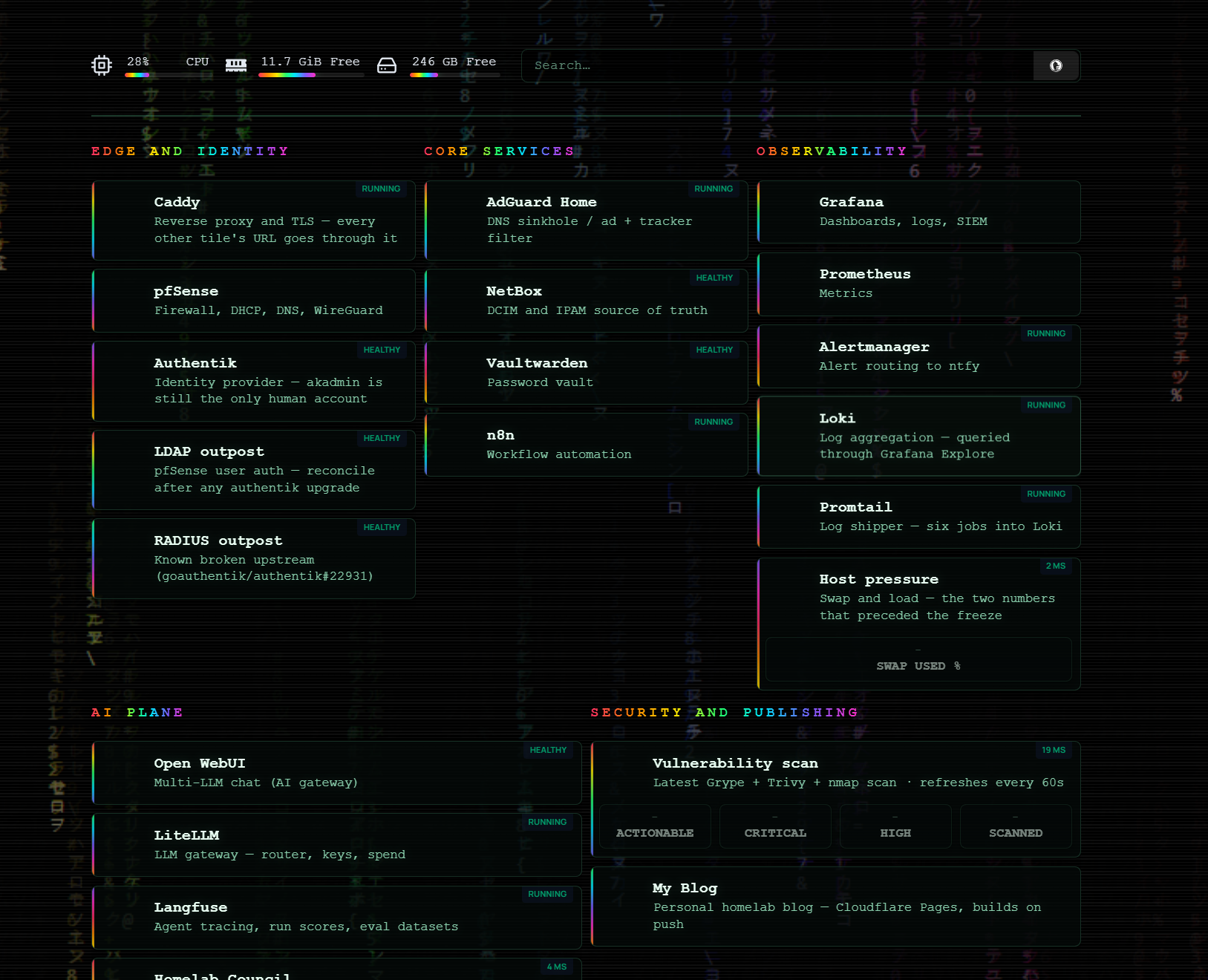
The desktop icon opens the dashboard now. A second launcher keeps the Textual interface, which is still the answer over SSH and when the dashboard is down — the terminal became the fallback rather than the front door.
332 tests. Six bugs, all found by using it rather than by testing it, which is its own lesson: I had good coverage of the layer I understood and none of the layer I’d just written.