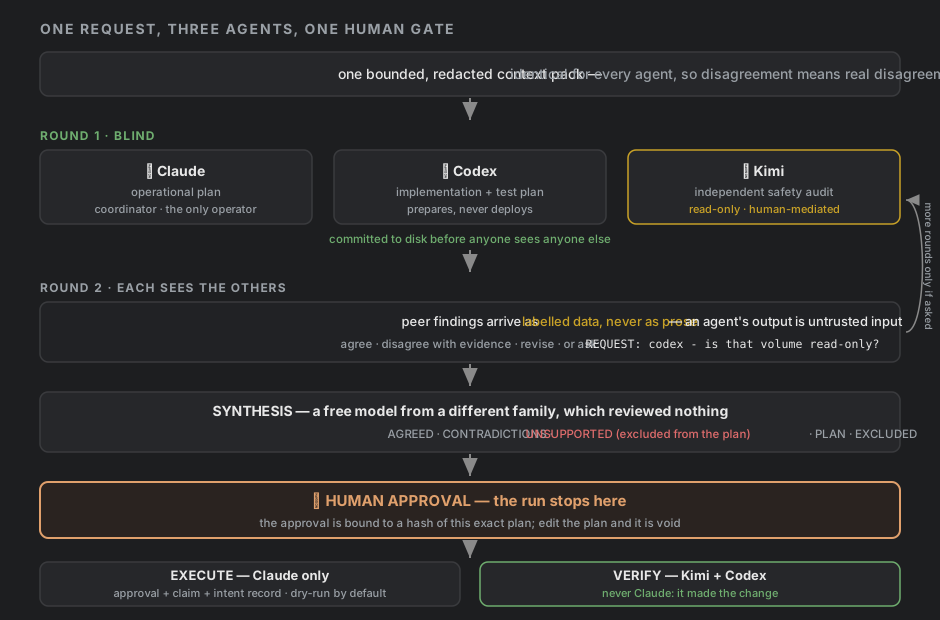
Pipeline diagram: one context pack fans out to Claude, Codex and Kimi in a blind first round, then a peer round, then a free model synthesises, then a human approval gate, then execute and verify

Three Agents, One Approval Gate — Making Claude, Codex and Kimi Review Each Other

I have three coding agents with access to this lab. Claude Code does most of the building. Codex reviews and runs the scans. Kimi audits. Until this week they had never exchanged a word — each got its own context, its own session, and its own chance to be confidently wrong with nobody checking. So I built a thing that makes them work one request together, and put a human approval gate in front of anything that changes the lab. ...
19 August 2026 · 11 min
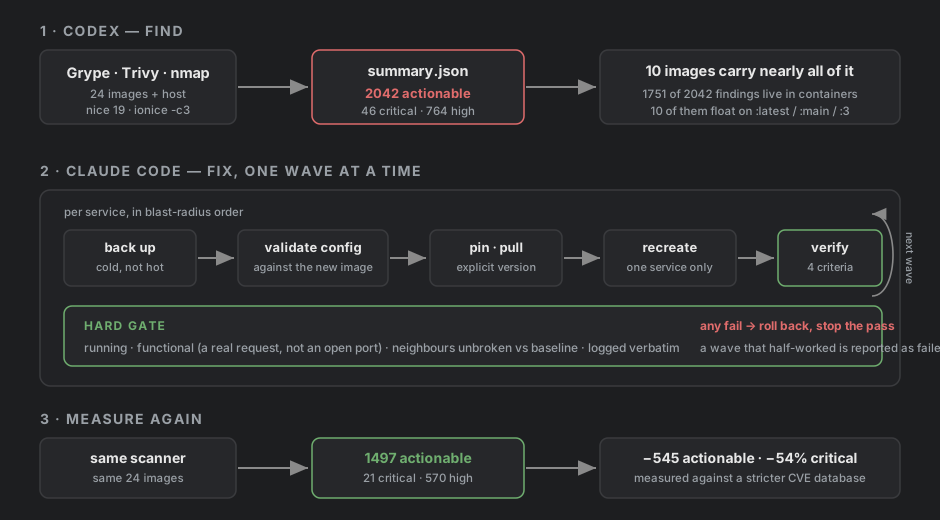
Pipeline diagram: Codex scans 24 images and finds 2042 actionable findings, Claude Code fixes them one wave at a time behind a hard validation gate, then the same scanner measures again at 1497

A Vulnerability Scan From Codex, a Container Upgrade From Claude Code

I run two coding agents against this lab. Codex found the problem and Claude Code fixed it, and keeping those two jobs in different hands turned out to be the most useful part of the whole exercise. The short version: a full vulnerability scan reported 2042 actionable findings — 46 critical, 764 high — and 1751 of them were in container images. Ten waves of updates later, the same scanner reports 1497 actionable, 21 critical, 570 high. ...

18 August 2026 · 10 min
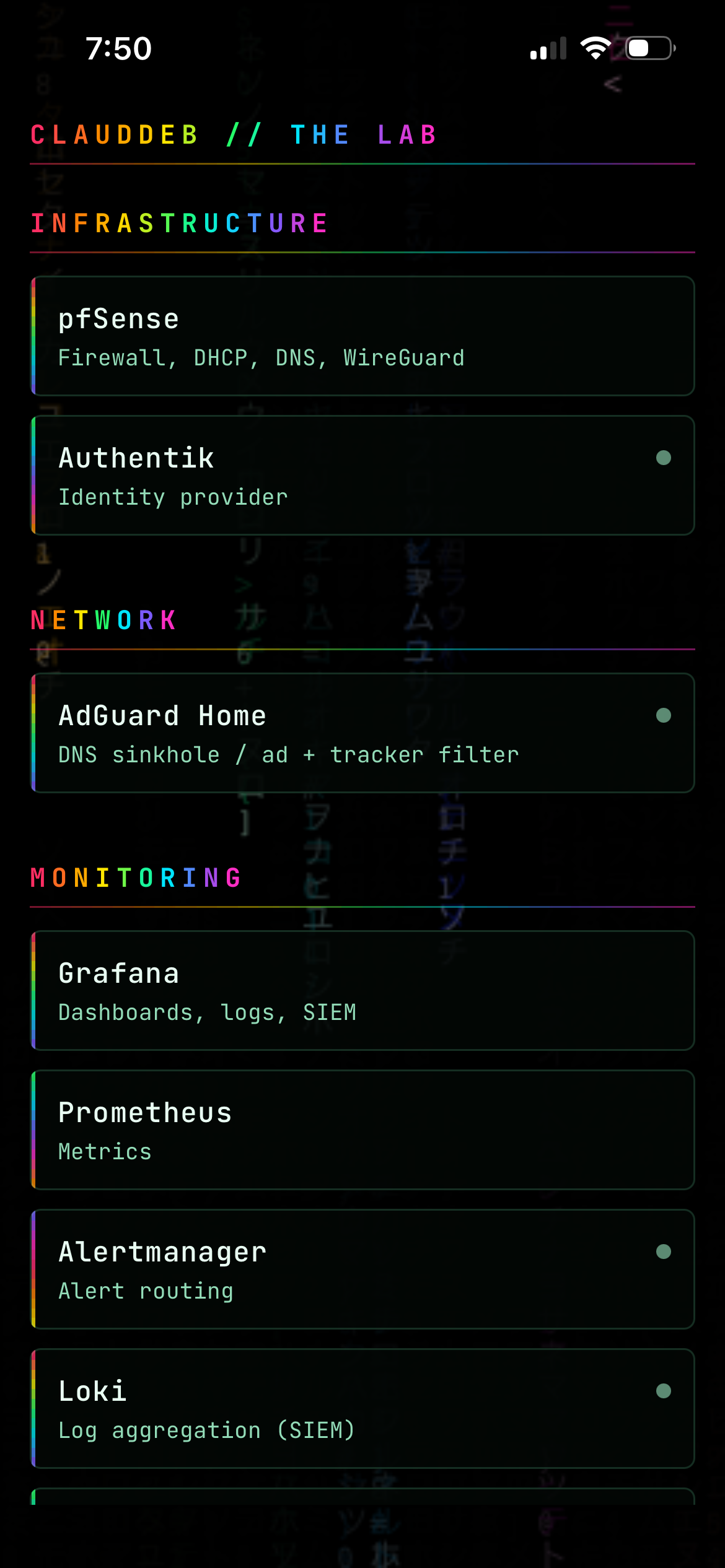
The LABDECK app on an iPhone, showing home lab service groups over an animated matrix rain background

LABDECK — Putting My Home Lab Dashboard on My Phone

A while back I built a front door for the home lab — one Homepage dashboard listing every service, with live status dots. It’s the page I look at most. On a phone it’s a browser tab. It works, but it’s a shrunk web page: no icon, no native controls, and every visit is a fresh Authentik redirect. I wanted the same thing as an actual app. This is how that went, including the parts that didn’t work. ...

9 August 2026 · 8 min
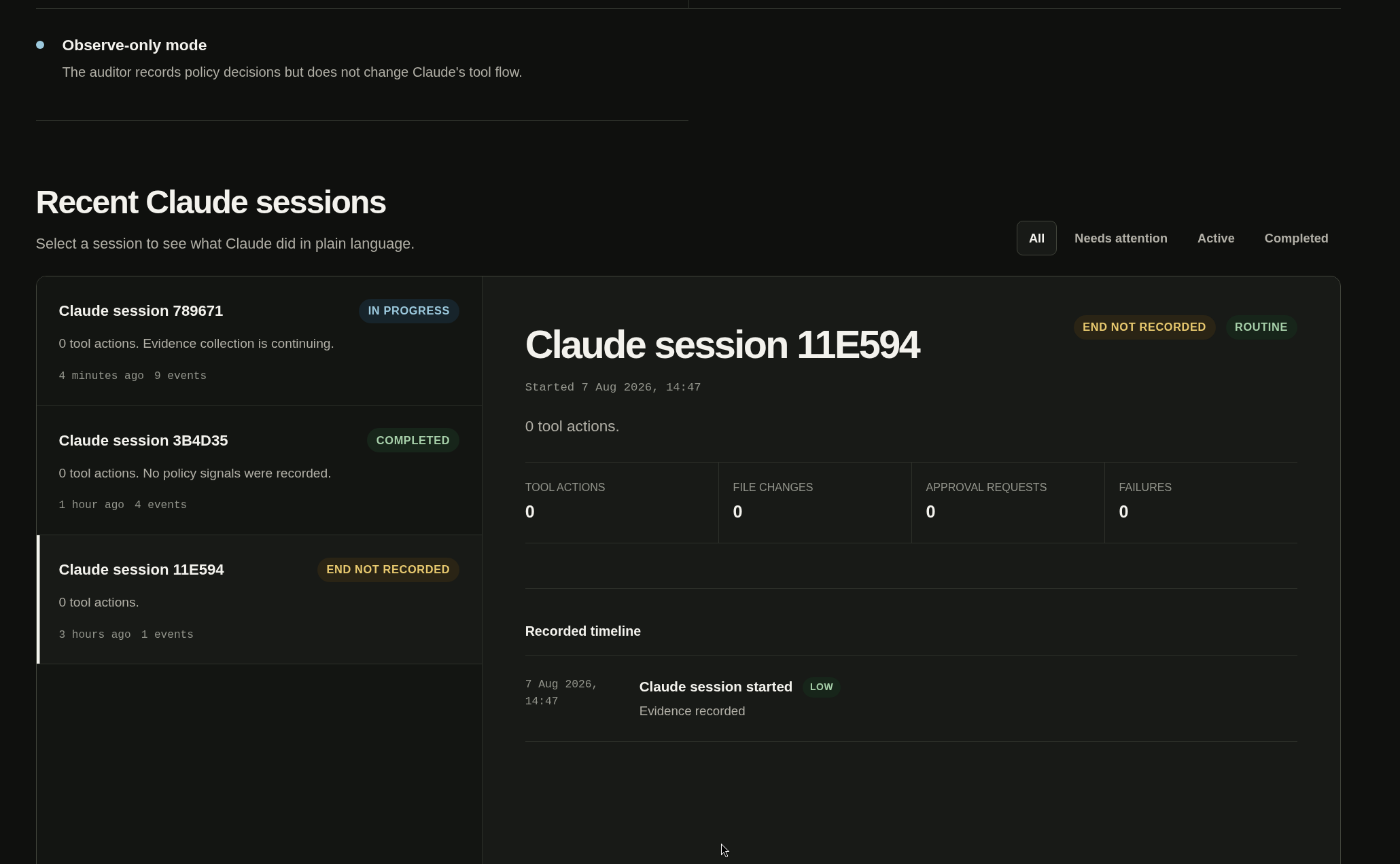
The agent auditor's local operator dashboard, showing observe-only mode and a list of recent Claude sessions with their recorded timelines

Auditing the AI Agent That Runs My Homelab

My homelab has picked up a lot of moving parts this year, and several of them are now LLMs. Claude Code runs natively on the box and does real work against real infrastructure — containers, reverse proxy config, monitoring, the lot. That’s genuinely useful. It also creates a trust problem I hadn’t had before. The problem is simple to state: the same agent that makes a change also writes the summary explaining why the change was safe. That’s convenient. It is not independent verification. If the agent quietly skips a validator and then reports “config validated”, I have no signal at all. The report is the evidence, and the thing that wrote the report is the thing being checked. ...

7 August 2026 · 9 min
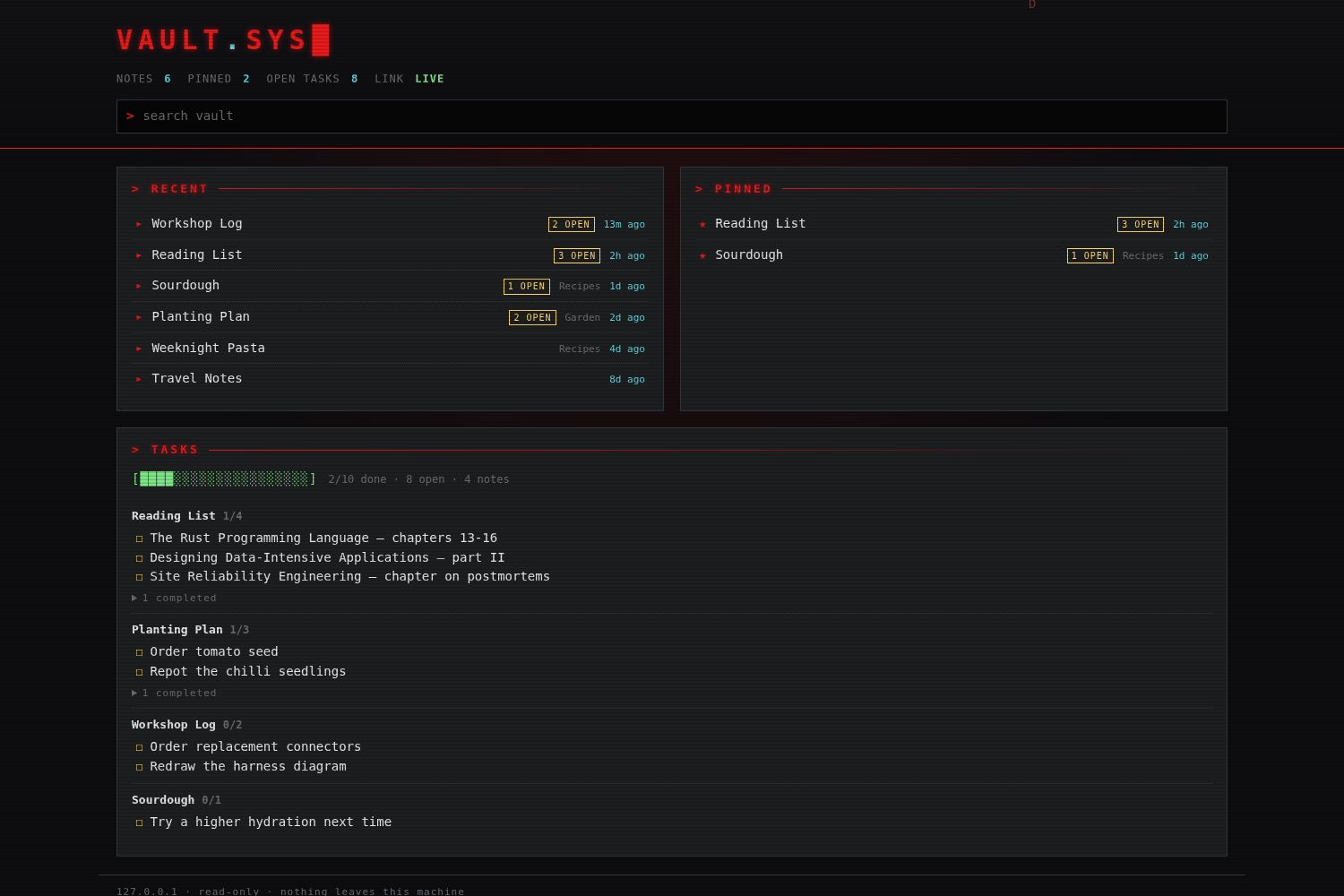
A dark red-on-black terminal-style dashboard showing RECENT, PINNED and TASKS panels over a set of markdown notes

A Read-Only Dashboard for My Obsidian Vault

My Obsidian vault has 61 notes in it — study notes, homelab runbooks, session logs — and it syncs between this box and my laptop. The only way to see what I’d touched recently was to open Obsidian and read Home.md, a hand-maintained index that goes stale the moment I forget to update it. So I wanted a small dashboard: recent notes, pinned notes, what’s still unticked. Local only. I didn’t write this code. I gave Claude Code the prompt and reviewed, tested and corrected what came back. That’s how most things on this blog get built now, and it seems worth being plain about. The prompt was: ...

3 August 2026 · 6 min
RAINBOW MATRIX cover — the post title in rainbow monospace over falling matrix rain on black

A Self-Hosted Multi-LLM Gateway for My Homelab

Claude Code is the main LLM running my homelab. It builds, debugs, and documents most of what happens on the Debian VM. But I wanted to try other models — and give the CLI tools a shared backend — without wiring up a different SDK and API key for every provider. So I put a gateway in front: one endpoint, many models. Claude stays the main driver; everything else is now one config line away. ...

29 July 2026 · 5 min
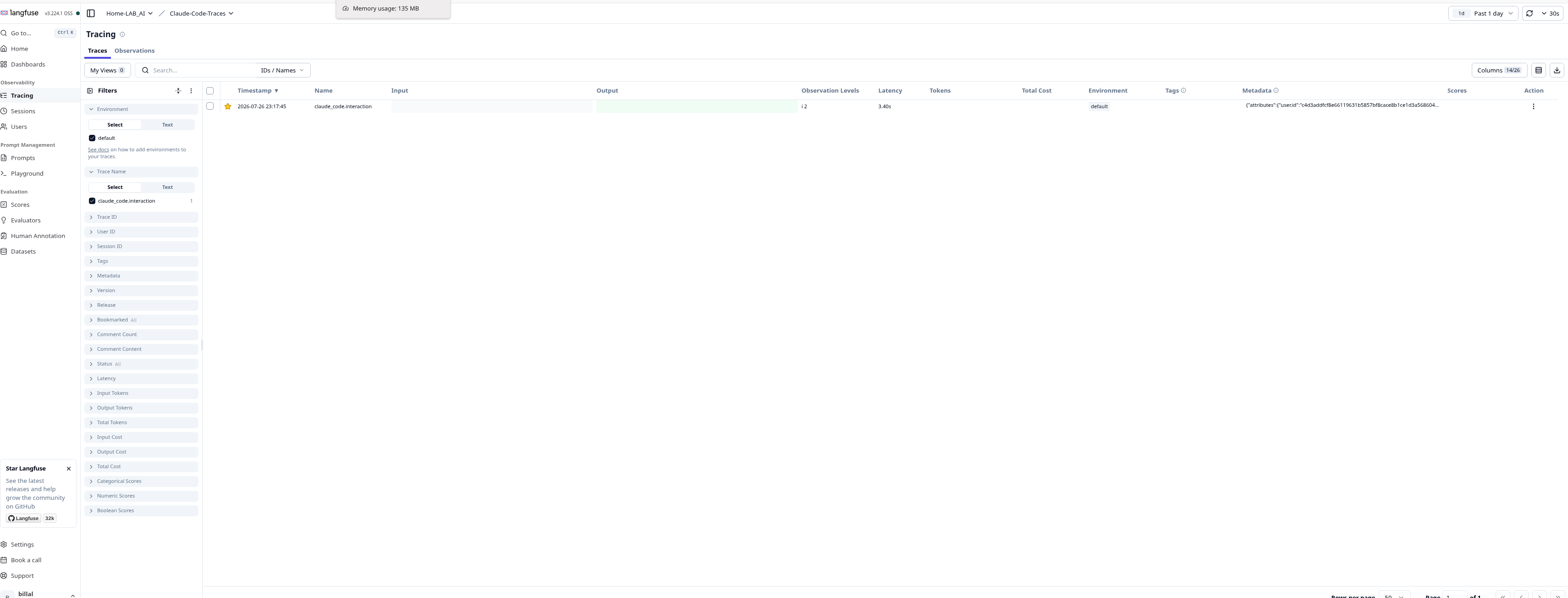
Langfuse's Tracing view showing a single claude_code.interaction trace with 2 observations and 3.40s latency

Implementing Langfuse to Monitor Claude Code

We all tend to focus on the output of whatever LLM we’re using — did it get the answer right, was it fast, was it useful. What I’d stopped paying attention to was the background: how many tokens a session was actually burning, where they went, and whether I’d have any way of knowing if something had gone quietly wrong. Claude Code runs natively on my homelab now, doing real work against real infrastructure, and I wanted more than “the output looked fine” as my only signal. ...

27 July 2026 · 4 min
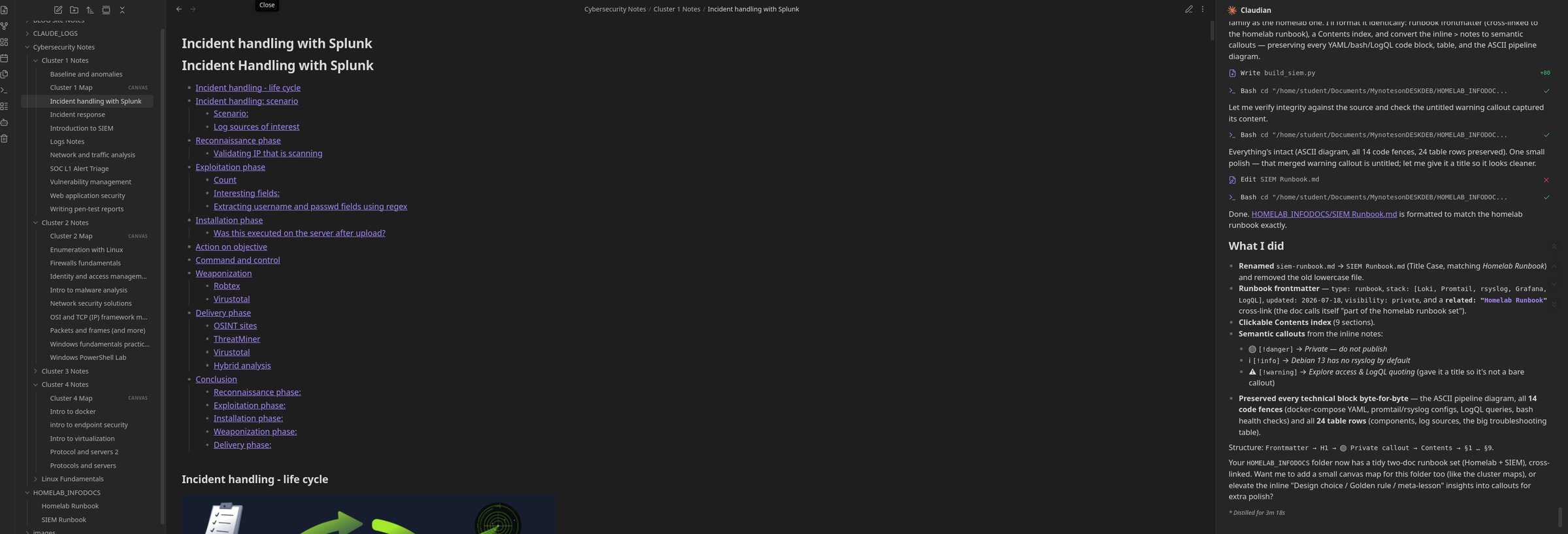
Obsidian with the Claudian sidebar open — Claude reformatting a SIEM runbook with tool calls visible

Claudian: A Claude Agent Inside My Obsidian Vault

My study notes live in Obsidian. My agent lives in a terminal. For a month those were two separate worlds: when I wanted Claude to clean up the vault, I drove Claude Code at it from outside — point the CLI at the folder, describe the job, check the result in Obsidian afterwards. Claudian collapses that into one window. It’s an open-source community plugin that embeds Claude Code inside Obsidian as a sidebar — the vault becomes the agent’s working directory, and the agent becomes part of the note-taking app. ...

18 July 2026 · 4 min
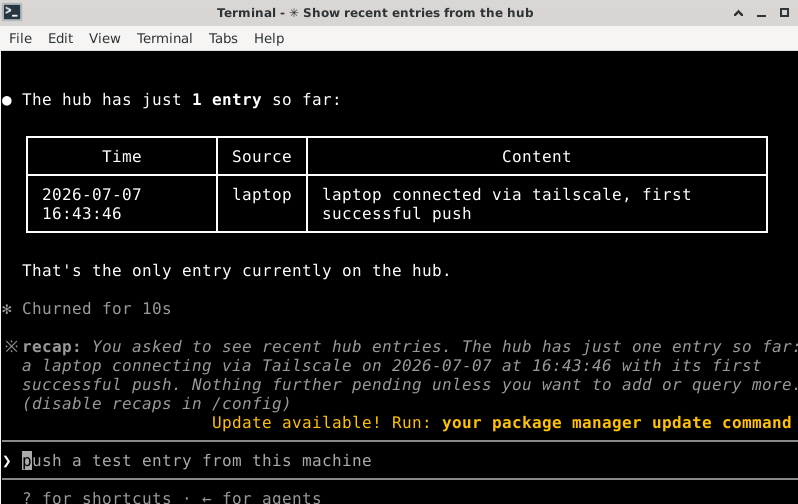
A note pushed from the laptop appearing on the hub via get_recent

Syncing Claude Code Across Devices with a Custom MCP Hub over Tailscale

I run Claude Code on two machines: the Debian VM in my home lab (always on) and a Debian laptop (sleeps, roams, follows me to campus). I wanted the laptop to push notes, facts, and findings into a central store on the VM — from any network — so the home-lab agent could pick them up later. Claude Code’s built-in Remote Control turns a second device into a remote window onto one session. That’s not what I wanted. I wanted both machines to stay fully independent agents, linked through a shared tool. So I built a small MCP server on the VM and pointed the laptop’s Claude Code at it: the hub becomes just another tool the laptop can call. ...

7 July 2026 · 6 min
SPT-AKI gameplay

Porting a Mod Through Claude Fable 5

This is my second SPT mod port — the first was BiggerBang, a full trader mod. This one is smaller in scope, but I ran the entire process through Claude Fable 5 in Claude Code: extraction, code review, the rewrite, and the debugging. My role was direction and judgement calls; the model did the implementation. The most interesting part of this post is what it found. ...

3 July 2026 · 5 min
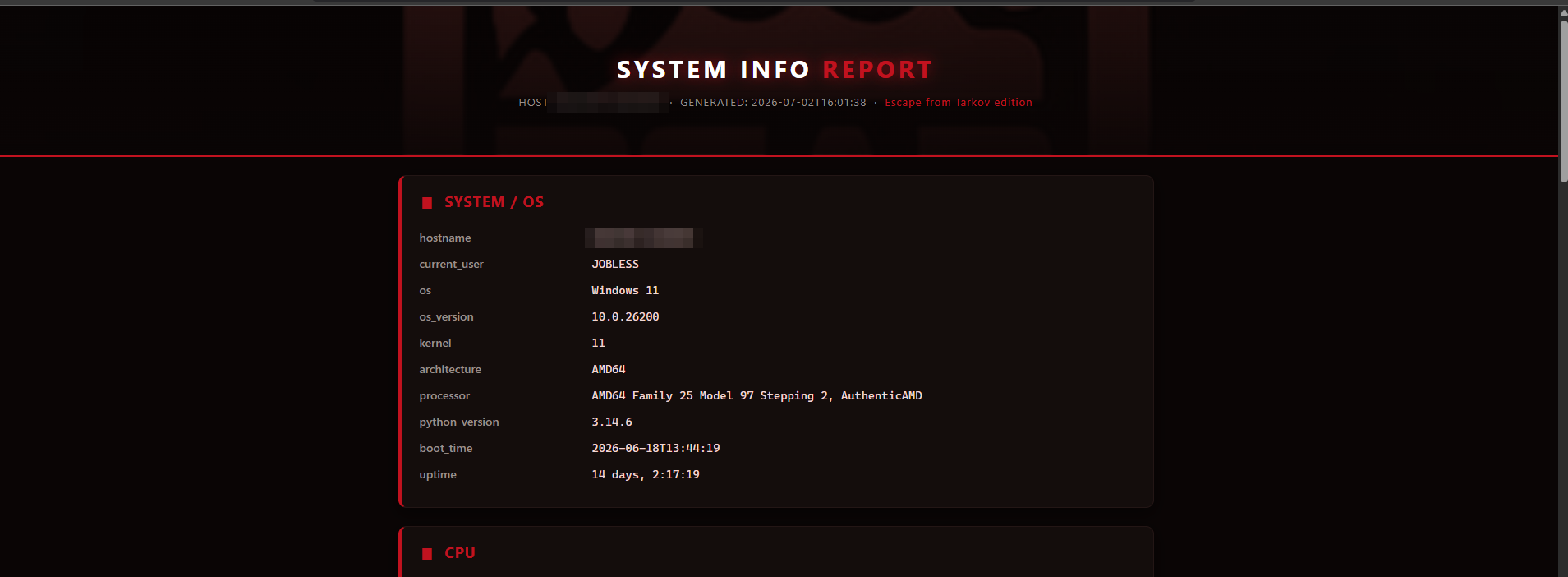
The Spec Grabber HTML report

Created a SystemInfo Grabber Program with Claude AI

I wanted a small desktop tool that captures a snapshot of a machine — hardware, resource usage, network state — and writes it to a styled HTML report viewable in any browser. Useful for quick system audits and for keeping a record of a machine’s specs over time. I built it in one Claude Code session (Opus 4.8) on my Debian 13 laptop, then packaged it for Windows as well. ...

2 July 2026 · 4 min
Escape from Tarkov

Porting a TypeScript Game Mod to C# and Hardening It for Community Release

SPT-AKI (Single Player Tarkov) 4.0 rewrote the entire server from JavaScript/TypeScript to C#/.NET. Every SPT 3.x mod — loaded as .ts/.js files with a package.json — had to be rebuilt as a compiled .dll against the new C# API. The mod I ported is BiggerBang, written for SPT 3.9 by Thunderbags, whose author had gone inactive. It adds a full custom trader (Boris Bangski) with an extensive inventory — ammo, weapons, magazines, grenades, injectors, containers, armour, equipment sets — and 13 quests. I ported it to C# for SPT 4.0.x, verified it against 4.0.13, fixed five bugs found along the way, and released it to the community. ...

29 June 2026 · 3 min
The Hugo blog running on GitHub Pages

Self-Hosting a Hugo Blog with a Claude Code Publishing Pipeline

The blog you’re reading was published by the pipeline this post describes. Why Hugo, and why self-hosted I needed somewhere to document real technical work — networking, security, mod projects — that I could point to from LinkedIn. Hosted platforms were out: no content ownership, paywall friction, someone else’s branding. Hugo won on attack surface. It’s a single Go binary — no Node, no node_modules, no npm dependency tree to patch and audit. For a security portfolio, the blog itself should be as defensible as the work it documents. It builds to plain static files, so serving is trivial; the trade-off is owning uptime and patching, which for this use case is a feature. ...

29 June 2026 · 3 min